
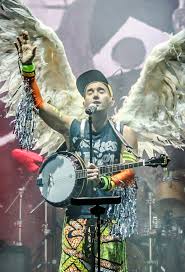
I was first introduced to the music of Sufjan Stevens in 2015 with the release of his album Carrie and Lowell. My first taste of this man’s exceptional talent was his song Fourth of July, written about the death of his mother. In fact, all of Carrie and Lowell is about his relationship with his parents, especially his mom, through all its ups and downs. What struck me is that through it all, Sufjan expressed his grief, pain and confusion in inexplicably beautiful ways. Fourth of July was haunting and yet tender all at once.
It goes without saying that Sufjan has a gift. As I continued to explore his music I came across indications that he was creating art from a Christian perspective. Spiritual themes are not hard to find in his work. However, Sufjan, ever the hipster, never comes out and declares his faith explicitly. This has led many to debate whether or not he is a Christian or not. Some songs even seem to betray doubt and unbelief. In Casimir Pulaski Day Sufjan bemoans the death of a friend with the line “All the glory when he took our place
But he took my shoulders and he shook my face
And he takes and he takes and he takes“.
Other lines that throw doubt on Sufjan’s “orthodoxy” include this line from Vesuvius: “For in life
As in death
I’d rather be burned
Than be living in debt”.
Ultimately, its not up to me to decide or even determine whether or not Sufjan Stevens is “saved” or “born again”. But another dimension to the debate occurs when we examine songs like To Be Alone With You which could be a worship song about all that Christ sacrifices for a relationship with humanity…or, as some have theorized, a song to a homosexual love interest.
And this is where the crux of the issue becomes apparent and we realize the grandeur of Sufjan Stevens as an artist.
Sufjan has mastered the art of inspiring art within his patrons, that is, kindling the art of interpretation. As a poet myself I know that some of my art is connected to personal experiences that no one else will ever understand and thus, the true “meaning” of some of my art will be lost to the reader because they don’t have the experiences to interpret it.
Artists naturally inject their experiences and worldview into their work. Some try to hide it more than others, some proudly express it and some, like Sufjan, neither try to hide or preach, they simply create. This third type of artist is sometimes the most excellent. If you read the comments on a Sufjan Stevens music video on Youtube you find something remarkable. People constantly share about their own lives and how they relate to the art in question. (This is observable with other artists who reside in the third category above, like Bon Iver.) People share about how one of Sufjan’s songs “spoke” to them or how they have a special memory associated with his art. Sufjan leaves his music open enough to let people find themselves in it, like finding their face in a painting. He is honest in his lyrics but still vague enough to kindle his listeners to enter into the artistic process and create their own interpretation.
So, in the example of To Be Alone With You, I enjoy the song as an adoration of Christ’s love for us as he lays down everything for a relationship with his creation. Whether that was Sufjan’s original intended meaning or not, that is the significance I’ve found. Thanks to Sufjan’s open approach to art, we, the listeners, are encouraged to engage in our own artistic process, to paint meaning on the canvas provided.
Perhaps, as artists, we can learn a lesson from Sufjan in this regard. Sometimes, great art offers us more questions than answers. Sometimes it leaves more room for interpretation than filling that same space. To truly engage our listeners/readers/viewers/patrons on the deepest level, let’s practice kindling the art of interpretation through being open in our art and not always spelling out the significance we personally associate with our creation.